Puerto Rico: Plantains and Protest
Puerto Rico: Plantains and Protest

On paper, Puerto Rico isn't a country. But, its soul says otherwise. From the moment Spanish conquistadors arrived in the 16th century, the island’s people; Taíno rebels, enslaved Africans, and jíbaro farmers, have refused to bow quietly to empire. Under the brutal system of encomiendas, Indigenous resistance burned hot; uprisings like the 1511 Taíno revolt shook the early colonial order. When the Spanish tightened their grip, Africans brought to toil in the cane fields carried with them rhythms of resistance, blending their traditions with those of the Taíno and Europeans to create a new, creole culture that was as unbreakable as it was beautiful.
By the 19th century, the island’s fields were drenched in sugar and sweat. As the profits of empire flowed outward, cries for independence echoed through mountain towns and coastal plantations alike. The 1868 El Grito de Lares, though quickly suppressed, became a spark that refused to die. It was the declaration that Puerto Rico would not be content as someone else’s property. Even after the Spanish-American War of 1898 handed the island from one empire to another, resistance merely changed its banner. The sugar barons of the early 20th century found themselves challenged by organized labor. The 1905 Sugar Strike, the general strikes of the 1930s, and the uprisings of the Puerto Rican Nationalist Party in the 1950s all made one thing clear: Puerto Ricans would not quietly accept colonial capitalism under a new flag.
The postwar period brought a different kind of domination. Under Operation Bootstrap, factories replaced fields, but exploitation remained. Peasants became factory workers; their lives modernized but not liberated. Riots and student protests shook San Juan through the 1940s to 1960s, as the island was remade to fit U.S. corporate interests. Even migration became a political act; those who left for New York and Chicago built diasporic communities that turned their struggle into global resistance. In the 1960s and 70s, groups like the Young Lords redefined Puerto Rican pride, transforming kitchens, clinics, and classrooms into frontlines of the movement.
And still, the fight continues. In the 21st century, Puerto Ricans have faced debt crises, natural disasters, and political corruption, all legacies of colonial neglect. But from the 2019 Verano Boricua protests that forced Governor Rosselló’s resignation under the slogan “Ricky Renuncia”, to the ongoing demand for self-determination, the spirit remains unbroken. Crowds fill the plazas and highways, dancing and chanting in defiance, fueled by the same resilience that sustained generations before them.
Through every era of rebellion, food has been at the center. Puerto Rican cuisine, born of Taíno roots, African creativity, and Spanish influence, tells the story of endurance as much as resistance. Every dish is a record of survival, a reminder that even under occupation, the kitchen remained a place of power.
This post celebrates seven dishes that carried the people through their struggles. We begin with Mofongo, a plantain mash that sustained Taíno rebels in the 1511 uprising against Spanish enslavement. Then Arroz con Gandules, the island’s beloved rice dish, which fortified revolutionaries during the 1868 El Grito de Lares. Chicharrones, crispy pork cracklings, nourished strikers amid the 1905 Sugar Strike. Pastelillos, golden fried turnovers, fed nationalists during the uprisings of the 1950s. Bacalaitos, salty cod fritters, sustained protesters through the anti–Operation Bootstrap riots of the mid-20th century. Pollo Guisado, a hearty chicken stew, warmed families and crowds through the 2019 Verano Boricua. Finally, Jibarito, the plantain sandwich born in the diaspora, embodied the grit and pride of the Young Lords Movement in the late 1960s and 70s.
So heat up the oil and start mashing plantains, as we explore the food, and history of one of the world’s last remaining colonies.
Mofongo: The Pounded Cry of the Taino
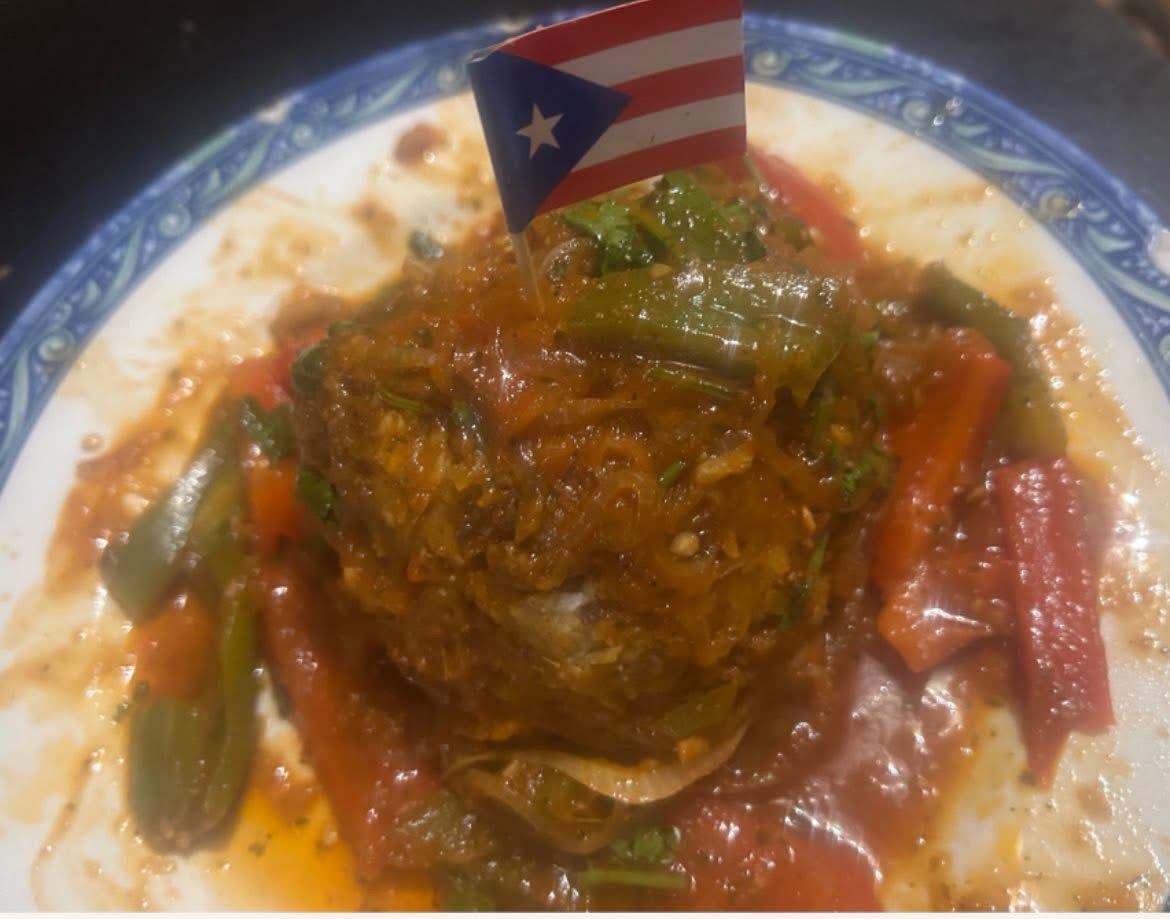
Mofongo, a hearty mash of fried green plantains that could humble any gourmet, reigns as Puerto Rico’s unofficial national dish; a dense, savory dome often filled with shrimp, pork, or chicken and drenched in garlicky broth. It’s a food that seems simple, even rustic, yet inside that mortar lies centuries of conquest, survival, and reinvention.
Its roots reach deep into the brutal soil of the 16th century. Mofongo was born from the crosscurrents of colonialism across three continents. Its ancestry begins with fufu, a West African staple of mashed yams or cassava, carried across the Atlantic by enslaved Africans chained in the holds of Spanish galleons. In the Caribbean, they found no yams, but they found plantains, brought earlier by the Spanish from Africa and quickly naturalized to the tropical soil. The Africans took the familiar rhythm of mashing, and made something new.
The Taíno, Puerto Rico’s Indigenous people, contributed more than just tools. Their pilón, a wooden mortar and pestle used to crush cassava and herbs, became the vessel of this new creation. Their influence lived on through technique, through the rhythm of pounding that had once prepared cassava bread and now gave birth to a hybrid dish that bridged worlds. The Spanish, for their part, added the ingredients of empire; garlic, olive oil, and chicharrones; layering European flavor atop African method and Taíno tool. By the mid-19th century, recipes appeared for “mofongo criollo,” a creole mash representing Puerto Rico’s tri-continental soul: African resilience, Taíno earthiness, and Spanish spice.
To make it was (and remains) an act of labor and love. Green plantains are sliced, fried golden in lard, and pounded in the pilón with salt, garlic, and bits of pork crackling until they yield, molded into balls or cups to be filled with whatever the day offers. For centuries, it was a poor person’s feast, made from humble ingredients for bodies worn by plantation toil. But its power goes beyond the palate.
Because to truly understand mofongo, you must return to the island’s first great uprising, the Taíno Rebellion of 1511, the thunderclap that began Puerto Rico’s long history of defiance and rebellion. The Taíno, who had greeted Columbus in 1493 with open hands, soon found themselves shackled under the encomienda system, a polite word for slavery. Governor Juan Ponce de León forced them into mines and fields under the guise of “protection.” Families were separated, villages razed, and the population, once numbering in the hundreds of thousands, collapsed under disease, starvation, and despair.
And yet, amid ruin, resistance stirred. The legend says that a Taíno cacique, Agüeybaná II, ordered a test. His lieutenant, Urayoán, lured a Spanish settler named Diego Salcedo to a riverbank, drowned him, and watched. If the Spaniard were divine, his body would rise. It didn’t. When Salcedo’s corpse rotted like any man’s, word spread through the forests: the invaders were mortal. The myth of Spanish godhood died that day, and the Taíno prepared for war.
In February 1511, the island erupted. Villages united under Agüeybaná II’s banner. Warriors armed with macanas, wooden clubs hardened by fire, struck Spanish settlements, burned crops, and cut down overseers. They moved swiftly through the dense hills of Yagüez, their knowledge of the land outmatching Spanish steel. Chroniclers later wrote with grudging respect, calling the Taíno “fierce and warlike.” For months they held the mountains and forests, laying siege to Caparra, the island’s first Spanish capital. But against muskets, armor, and horses, they stood little chance. Agüeybaná II fell in battle. His people were slaughtered or enslaved. The uprising was crushed, but not forgotten.
That rebellion, though doomed, became the heartbeat of Puerto Rico’s story. The Spanish may have won the island, but they never conquered its spirit. As the Taíno bloodlines intertwined with those of Africans and Spaniards, a new Puerto Rican identity emerged. And in the kitchen, that identity found voice. The same pilón that had once ground cassava now pounded plantains into mofongo, fusing old and new.
Through the centuries, mofongo traveled from plantations to parlors, and from jíbaro huts to San Juan kitchens. It is eaten after hurricanes, at protests, at wakes, and at weddings. It has fed soldiers, strikers, and students.
For my own part, I doused it in a tomato based broth. But, the dish is famously adaptable.
Mofongo
Ingredients (4 servings):
- 3 green plantains, peeled & cut into 1-inch chunks
- 4 cloves garlic, minced
- 4 tbsp olive oil (or lard)
- ½ cup pork cracklings (chicharrón) or crispy bacon bits
- 1 cup chicken broth, hot
- Salt, to taste
Instructions:
- Fry plantain chunks in oil at 350°F until golden and cooked through (8–10 min).
- In a mortar & pestle (pilón), mash garlic with olive oil and salt into a paste.
- Add fried plantains and mash with garlic paste. Work in chicharrón.
- Shape into a ball or mound. Moisten with chicken broth for softness.
- Serve with broth, shrimp, or pernil on the side.
Simple Salsa Criolla for Mofongo
Ingredients (about 2 cups):
- 2 tbsp olive oil
- ½ onion, sliced thin
- ½ green bell pepper, sliced thin
- ½ red bell pepper, sliced thin
- 2 cloves garlic, minced
- 1 tsp oregano
- 2 tbsp sofrito (optional but authentic)
- ½ cup tomato sauce (or crushed tomatoes)
- ½ cup chicken broth (or seafood stock if serving with shrimp/fish)
- 1 bay leaf
- Salt & pepper, to taste
- Chopped cilantro, for garnish
Instructions:
- Heat olive oil in a pan over medium heat.
- Add onion and peppers. Sauté until softened (5–7 minutes).
- Stir in garlic, oregano, and sofrito. Cook until fragrant (about 1 minute).
- Add tomato sauce, broth, and bay leaf. Stir and bring to a simmer.
- Let it cook gently for 10–15 minutes until slightly thickened.
- Season with salt, pepper, and finish with fresh cilantro.
Sofrito Recipe (Puerto Rican Base)
Ingredients (makes about 2 cups, can be frozen):
- 1 large onion, roughly chopped
- 1 green bell pepper, chopped
- 1 red bell pepper, chopped
- 10 cloves garlic, peeled
- 1 bunch cilantro, chopped (about 1 cup)
- 1 bunch culantro (recao), chopped (if available, ~½ cup)
- 2 ají dulce peppers (or ½ red bell pepper if unavailable)
- 2 tbsp olive oil
- Salt, to taste
Instructions:
- Combine all ingredients in a blender or food processor.
- Pulse until a smooth but slightly chunky paste forms.
- Store in an airtight jar in the fridge up to 1 week, or freeze in ice cube trays for long-term use.
- Use 2–3 tbsp as the flavor base for rice, stews, beans, and meats.
Arroz con Gandules: Rice of the Rebel
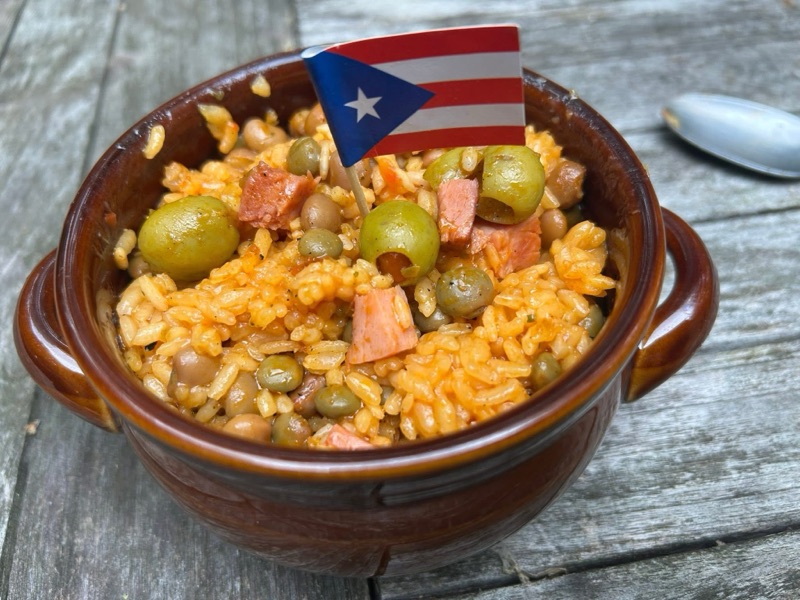
Arroz con Gandules, or “rice with pigeon peas,” stands as the king of Puerto Rican cuisine. A pot of seasoned rice, speckled with tender pigeon peas, simmered in sofrito and kissed by pork fat, it’s the dish that never leaves the island’s tables, appearing at feasts, weddings, birthdays, and Sunday dinners alike.
The roots of this iconic dish stretch back through centuries of exchange and exploitation. Before 1493, the Taíno people of Borikén, Puerto Rico’s original name, cultivated cassava, corn, and yautía, building their diets on what the fertile island soil provided. Then came Columbus, the Spanish flag, and with them, the transformation of an island. Rice, a grain that had traveled from Asia to Europe via Moorish Spain, arrived in the Caribbean through colonial trade. Pigeon peas, gandules, came from West Africa, carried across the Atlantic in the cruel holds of slave ships. Spanish colonizers brought pigs and olive oil. Africans brought the gandules and a culinary ingenuity born of necessity. From these collisions came sofrito: a base of onions, peppers, garlic, cilantro, and culantro, sautéed to a fragrant base that would become the center of Puerto Rican cooking.
Arroz con Gandules emerged from this mix; one pot, one flame, many hands. Its ingredients told the story of empire, but its spirit told the story of adaptation. The Taíno’s patience, the African’s endurance, the Spaniard’s technique, all fused into something distinctly boricua. Annatto seeds dyed the rice a sunlit gold, while olives and capers, reminders of the Mediterranean, dotted the dish like echoes of the old world. Pork shoulder or ham hock lent it depth, though in leaner times, even scraps of salted meat or nothing at all would do. It became a dish of the people; humble, nourishing, and infinitely sharable.
But to truly understand Arroz con Gandules, one must look beyond the kitchen pot, to the fires of rebellion that burned in Puerto Rican soil. For just as the dish was born from fusion, so too was Puerto Rican identity, forged in resistance against the empire that tried to claim it.
By the mid-19th century, Puerto Rico was a colony under Spain’s tightening grip. The Bourbon Reforms had turned the island into a tax farm for Madrid, bleeding its economy dry through monopolies and tariffs. Coffee, sugar, and tobacco lined Spanish coffers, while the working class, the jíbaros of the countryside, struggled under crushing poverty. Slavery persisted. Land ownership shrank to the hands of a few. The creole middle class, mixed-race intellectuals, and small farmers alike began to ask the forbidden question: what if Puerto Rico were free?
Among the exiled voices calling for change was Dr. Ramón Emeterio Betances, a physician of African, Taíno, and European descent, who treated slaves for free and organized clandestine abolitionist networks. Alongside him was lawyer Segundo Ruiz Belvis. Together, in 1868, from exile in the Dominican Republic, they founded the Comité Revolucionario de Puerto Rico—the Revolutionary Committee of Puerto Rico. Their manifesto, Betances’ Los Diez Mandamientos de los Hombres Libres (“The Ten Commandments of Free Men”), was a declaration of independence disguised as a moral creed: abolition of slavery, freedom of speech, the right to vote, to own property, to be educated.
What followed was the island’s first great cry for liberty: El Grito de Lares.
In the mountain town of Lares, on the night of September 23, 1868, hundreds of men and women gathered under the flicker of torchlight. They were farmers, seamstresses, freed slaves, students, merchants, a coalition as mixed as the ingredients in a pot of Arroz con Gandules. At the head was Manuel Rojas, a plantation owner turned rebel. Beside him, Mariana Bracetti, nicknamed Brazo de Oro (Golden Arm), who sewed the flag of the new Republic of Puerto Rico. The plan was bold but fragile: seize Lares, proclaim the republic, and ignite uprisings across the island.
They marched through the darkness, machetes glinting like lightning. They raided the Spanish garrison, took the town hall, freed prisoners, and raised the flag, red, white, and blue with a white cross dividing four rectangles, each symbolizing a different virtue. Francisco Ramírez Medina was named provisional president. Slaves were declared free. For a single, shining night, Puerto Rico tasted independence.
But dawn brought the counterstrike. Spanish forces from nearby towns advanced swiftly. Outnumbered and outgunned, the rebels scattered into the mountains. Within days, the uprising was crushed. Over 800 were arrested, including Rojas and Bracetti. Betances, watching from exile, saw his dream deferred but not destroyed. Spain’s reaction, part repression, part reform, revealed how deeply the Grito had shaken the empire. Slavery was abolished five years later, in 1873. The idea of self-rule, once whispered, could no longer be silenced.
Arroz con Gandules, like the Grito, outlived its suppression. The mingling of Taíno, African, and Spanish elements in the dish reflected the same fusion of races, classes, and creeds that had fueled the rebellion. In the simmering of the pot, one could hear echoes of secret meetings in mountain bohíos; in the scent of garlic and annatto, one could sense the same warmth that gathered revolutionaries around a fire, plotting the island’s future.
Today, Arroz con Gandules remains the soul of Puerto Rican cooking. It feeds crowds at protests, picnics, and Christmas feasts alike. It is comfort food, yes, but also a quiet act of remembrance. Every bite carries the legacy of the enslaved and the exiled, the jíbaro and the revolutionary, the cooks who stirred their pots while dreaming of a freer tomorrow. The rice, the gandules, the sofrito, they are the ingredients of identity itself, a reminder that Puerto Rico, though colonized, never surrendered its flavor.
Personally, it is my single favorite rice dish.
Arroz con Gandules (Puerto Rican Rice with Pigeon Peas)
Ingredients:
- 2 cups medium-grain rice, rinsed
- 3 tbsp sofrito
- 1 can (15 oz) gandules (pigeon peas), drained
- ½ cup tomato sauce
- ¼ cup diced ham or salted pork (optional)
- 3 tbsp olive oil
- 2 ½ cups chicken broth (or water + bouillon)
- 1 packet sazón with achiote
- 2 tsp adobo seasoning
- 2 tbsp green olives with pimento
- Salt & pepper
Instructions:
- Heat oil in a caldero or heavy pot. Sauté sofrito, ham, and tomato sauce until fragrant.
- Add sazón, adobo, olives, and gandules. Stir well.
- Add rice, coating grains in the mixture.
- Pour in broth. Bring to boil, then reduce heat.
- Simmer covered 20–25 min until rice is tender. Fluff with fork.
Chicharrones: The Crispy Crackle of Defiance
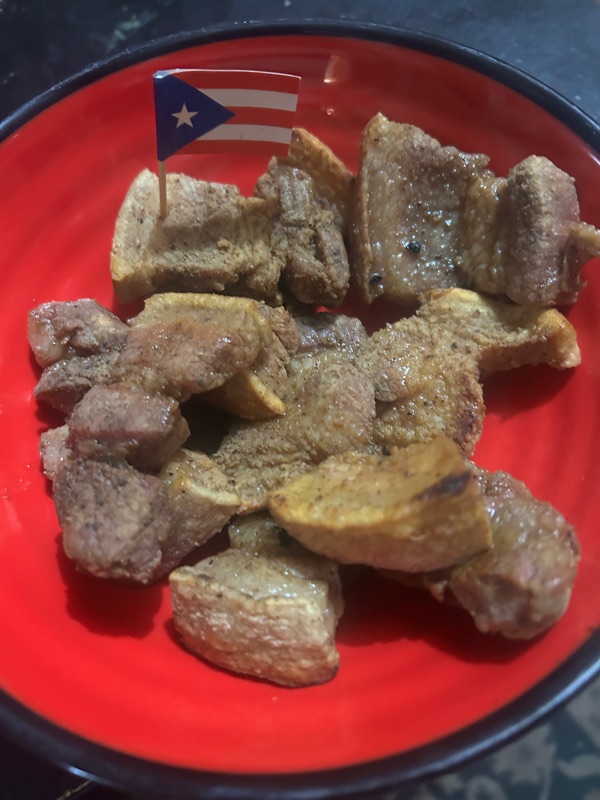
Chicharrones, are crackling morsels of fried pork belly and rind, that are ubiquitous in Puerto Rican kitchens. They are at once humble and celebratory, a dish born from scraps yet now found at every feast, from roadside kiosks in Bayamón to Christmas Eve tables across the island.
The story of the chicharrón begins not in the frying pan, but in the fires of colonial survival. When Spanish colonizers brought pigs to the Caribbean in the late 15th century, they were introducing an animal that would transform the island’s diet. Pigs multiplied freely, fattening in forests and fields, but their choicest cuts were reserved for the colonial elite. What was left, the skin, the belly, the bones, fell to the enslaved and the poor. From those leavings, the Taíno and African peoples of Puerto Rico forged something new. They rendered fat over open fires, seasoned it with native herbs and peppers, and learned that what others discarded could be turned into power.
By the 18th century, chicharrones were a common sight in fincas and marketplaces. In Bayamón, later crowned the “Ciudad del Chicharrón”, vendors could be heard from dawn till dusk, shouting over the din of sizzling lard. Workers lined up for paper cones of the crispy pork, each bite a cheap meal and a moment of satisfaction in a life of toil. They were portable, affordable, sustaining, the perfect food for a laboring people. But chicharrones were never just sustenance. They were proof that Puerto Ricans could take what was meant for waste and make it worthy of pride.
That spirit of transformation would carry forward into the next century, when the island once again found itself under a foreign yoke. In 1898, Spain’s fading empire collapsed, and Puerto Rico was seized by a new master: the United States. To Washington, Puerto Rico was not a nation, but a possession, a laboratory for “modernization,” a plantation reborn under new management. American sugar companies swept in, buying up vast tracts of land. The old jíbaro farmers, who had once grown coffee, tobacco, and fruit for local trade, were pushed out. In their place rose an industrialized sugar monoculture, run by corporations like the South Porto Rico Sugar Company, enforced by colonial administrators, and fed by the sweat of tens of thousands of rural laborers.
By 1905, those workers were at their breaking point. Wages had sunk to mere cents per day. Workdays stretched to fourteen hours beneath the punishing sun. Families lived in company barracks, their children pressed into labor before they were old enough to read. Hunger was constant. Hope was scarce. Yet, in the bohíos and communal kitchens that dotted the sugar fields, something was stirring, an anger that sizzled like pork skin in hot oil.
The Federación Libre de Trabajadores (FLT), Puerto Rico’s first major labor union and an affiliate of the American Federation of Labor, had existed since 1899. But its leadership, mostly artisans and urban workers, hesitated to confront the sugar barons directly. Out in the fields, however, the workers were less patient. In January 1905, small strikes began in the north. By March, they spread south to Ponce, Guayama, and Santa Isabel, the heartland of the sugar industry. In village squares and cane barracks, organizers met by candlelight, passing around leaflets printed by the radical press La Federación. Their demands were clear: end child labor, raise wages, shorten the workday to nine hours, and treat workers as human beings, not machinery.
The strike began in earnest on April 18, 1905. Over 20,000 workers, men, women, and children, walked off the fields in coordinated defiance. Sugar mills fell silent. Cane rotted uncut in the blazing sun. Governor William Hunt, fearing an island-wide rebellion, called in police and federal troops. The U.S. authorities arrested strike leaders and imported strikebreakers from the north. But the workers held the line. In Ponce, guards fired on crowds, killing several. In Guayama, machete-wielding field hands fought off hired thugs. It was a war for dignity waged with bare hands and brave hearts.
And through it all, the scent of frying pork lingered in the air. In the strike camps that dotted the countryside, women tended fires and fed the strikers. The cheapest meat, the trimmings left behind by the haciendas, became their fuel. Pork fat, salted skin, and garlic were thrown into bubbling pots, turning hunger into sustenance, despair into ritual. To eat chicharrones was to taste defiance itself: the transformation of scraps into strength, of poverty into pride. It was a dish that didn’t need permission, it demanded its own place at the table.
As historian Jorell Meléndez-Badillo later noted, the 1905 strike was shaped not only by class struggle but by imaginationl; a vision of a Puerto Rico where workers, not foreign capital, ruled their own labor. That imagination lived in the food, too. The frying of chicharrones became a kind of ceremony, a rhythmic act that echoed the pounding of machetes on cane and the beating of hearts in revolt. The women who cooked them were the quiet backbone of the movement, feeding families and fighters alike. The children who snuck bites between protests carried that taste into adulthood: the taste of rebellion.
By May, the strike was crushed beneath the boots of colonial power. Hundreds were jailed. Families were evicted from company housing. The FLT negotiated minor concessions; slight wage increases and promises to reduce child labor, but the sugar machine roared back to life. Yet, as with all great acts of resistance, defeat was only the beginning. The strike planted seeds that would bloom in later decades; the 1934 sugar strikes, the rise of nationalist movements, the unbroken thread of labor activism that endures in Puerto Rico to this day.
And chicharrones? They endured, too. From the embers of strike fires to the griddles of Bayamón, they became an emblem of Puerto Rican resilience; a dish of the people, by the people, for the people. Each golden curl of fried skin tells the same story: that what the world throws away, Puerto Rico reclaims. That even in hunger, there can be joy. That even in oppression, there can be flavor.
Today, chicharrones appear at festivals, roadside stands, and holiday feasts, alongside rice, plantains, and laughter. Some are made with chicken now (chicharrones de pollo), some with yuca or soy for a new generation of cooks, but the soul remains unchanged. When the oil pops and the skin crackles, it recalls that same unbreakable defiance from the fields of 1905. Puerto Rico may have been colonized many times, but never conquered in spirit. Its people, like their chicharrones, endure the heat and come out golden.
Making chicharrones is both rewarding and delicious. They can easily be used for a number of other recipes as well.
Pork Cracklings (Chicharrón) Recipe
Ingredients:
- 1 lb pork belly (skin on, cut into 1-inch cubes)
- 1 tbsp adobo seasoning (or salt, pepper, garlic powder mix)
- 1 tsp baking soda (helps skin crisp)
- Oil, for frying
Instructions:
- Season pork belly with adobo (or salt, pepper, garlic powder). Rub baking soda lightly onto skin.
- Heat oil in a deep pan to 350°F.
- Fry pork belly pieces in batches until skin puffs and turns golden, about 10–12 minutes.
- Drain on paper towels. Use chopped into mofongo or as garnish.
Pastelillos: Pockets of Puerto Rican Defiance
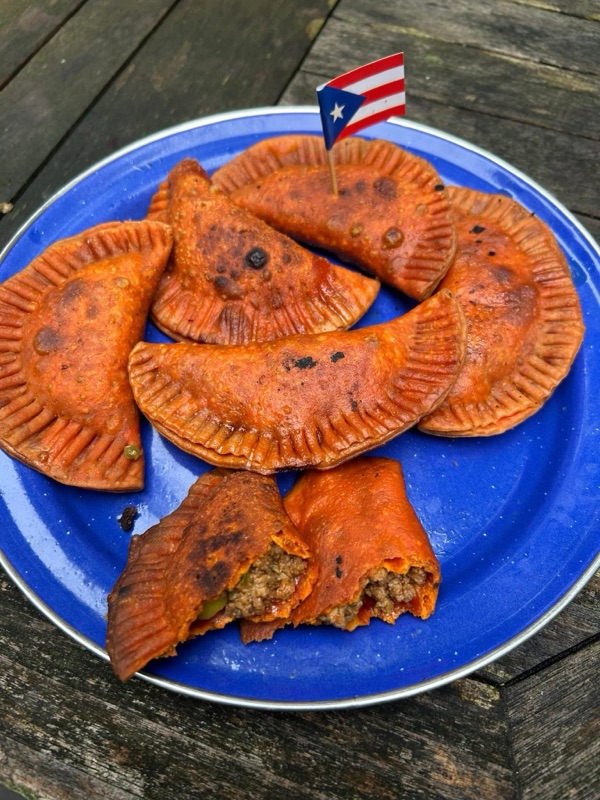
Pastelillos are Puerto Rico’s hand-sized fried turnovers, and far more than a snack. They’re the edible embodiment of an island’s defiance, a revolutionary meal disguised in dough. Every crimped edge hides a story: of survival, adaptation, and rebellion. On the surface, they seem simple; circles of dough folded over picadillo, sealed tight, and fried until they blister and bubble into flaky perfection. But inside, both literally and symbolically, they carry the island’s layered history, born at the crossroads of Taíno, African, and Spanish traditions.
The origins of pastelillos trace back to Puerto Rico’s colonial kitchens, where Indigenous, enslaved, and European influences simmered together. The Taíno people had long pounded root vegetables and maize into dough-like bases for cooking; when the Spanish arrived in the early 1500s, they brought wheat flour, lard, and the technique of frying pastries. Enslaved Africans introduced complex seasonings, garlic, pepper, annatto, and adobo, that transformed bland rations into expressions of flavor and resistance. From this fusion came the pastelillo: portable, cheap, and hearty, food that could travel with the worker, the fisherman, or the rebel.
By the 19th century, pastelillos had become fixtures of roadside stands and urban markets. Filled with whatever was available, spiced ground beef, bits of chicken, even leftover rice. They embodied the resourcefulness of a people making do under foreign rule. A proper pastelillo was both practical and poetic: dough rolled thin as paper, folded over a sofrito-scented filling, its edges pressed together with a fork to create that telltale ridge.
They were eaten on plantations and in factories, at festivals and on picket lines. Workers tucked them into cloths before heading to sugarcane fields owned by absentee American corporations, where 12-hour shifts paid barely enough to buy a handful of rice. Pastelillos became a worker’s currency of sustenance, small enough to carry, filling enough to last, and flavorful enough to remind them that joy could still survive inside hardship.
When the fires of the 1950 Nationalist Uprisings, known collectively as the Grito de Jayuya, ignited, pastelillos followed the rebels into the hills. Their story, like the uprising itself, begins with betrayal and ends with endurance.
After the United States seized Puerto Rico from Spain in 1898, it promised modernization but delivered dependency. The Jones Act of 1917 made Puerto Ricans U.S. citizens but denied them voting rights in federal elections. The island’s economy was swallowed by American sugar corporations. By 1950, nearly 80% of arable land was in corporate hands. Local farmers, or jíbaros, once the backbone of Puerto Rican life, became laborers on their own soil. Adding insult to injury, the Gag Law (Ley 53) of 1948 criminalized independence itself, banning flags, songs, and even the word “liberty.” It was illegal to be Puerto Rican in the fullest sense.
In this climate, one man emerged as the face of resistance: Pedro Albizu Campos, Harvard-educated, fiery, and uncompromising. To his followers, he was El Maestro, the teacher. To the U.S. government, he was a dangerous radical. Under Albizu’s leadership, the Puerto Rican Nationalist Party had already suffered bloodshed, most infamously in the 1937 Ponce Massacre, when police opened fire on unarmed protesters, killing 19. That day burned itself into memory, and Albizu’s faith in peaceful protest was extinguished. When he returned from prison in 1947, he found a people weary of promises and ready for action.
The spark came in 1950, when the U.S. passed Public Law 600, offering Puerto Ricans a “commonwealth” status that many saw as a façade of self-rule. For Albizu and his followers, it was the final insult, a gilded cage wrapped in patriotic ribbon. Planning for revolt began in whispers, in kitchens and workshops, under the hum of ceiling fans and the smell of frying dough. Blanca Canales, a schoolteacher from Jayuya, was among those who prepared pastelillos for secret meetings, passing plates of food that hid coded messages underneath.
On October 30, 1950, the island erupted. In Jayuya, Canales led thirty Nationalists to seize the police station, raise the banned Puerto Rican flag, and declare the island’s independence. In Utuado, rebels ambushed federal offices. In San Juan, gunfire echoed near the governor’s mansion. Across eight towns, coordinated attacks turned the island into a patchwork of rebellion. Days later, in Washington D.C., Nationalists Oscar Collazo and Griselio Torresola attempted to assassinate President Harry Truman, hoping to force the world to notice their struggle. Torresola died in the firefight; Collazo was captured, his sentence later commuted.
The U.S. responded with overwhelming force. Governor Luis Muñoz Marín, a supporter of commonwealth status, called in the Puerto Rican National Guard, backed by U.S. Air Force planes. Jayuya was bombed from the air, one of the only instances in U.S. history where American planes attacked their own citizens on domestic soil. Tanks rolled through the mountain towns. Hundreds were arrested. Albizu was imprisoned again, tortured until his body gave out. Canales, too, was captured and sentenced to life in prison, later pardoned.
But though the uprising was crushed, the idea behind it refused to die. And in homes across the island, pastelillos continued to fry.
Today, pastelillos are ubiquitous, from San Juan’s food trucks to family tables in New York and Orlando. You’ll find them stuffed with cheese and guava at fiestas patronales, filled with crab in coastal towns, or oozing with ground beef at baseball games. But whether they’re eaten hot from the fryer or cold from a paper bag, they remain what they’ve always been: food for the people, food of the struggle.
I like my pastillos with picadillo filling and stained red.
Puerto Rican Pastelillos (Empanadillas)
Ingredients:
- 1 pack frozen empanada discos (Goya brand works)
- 1 lb ground beef
- 3 tbsp sofrito
- ½ cup tomato sauce
- 1 packet sazón
- 1 tsp adobo seasoning
- 2 tbsp green olives, chopped
- Oil for frying
Instructions:
- Cook ground beef with sofrito, sazón, and adobo until browned.
- Add tomato sauce & olives. Simmer until thickened. Cool filling.
- Place spoonful of meat in each disco. Fold & seal with fork.
- Fry in oil at 350°F until golden. Drain & serve.
Bacalaitos: Fritters of Survival in the Shadow of Bootstrap
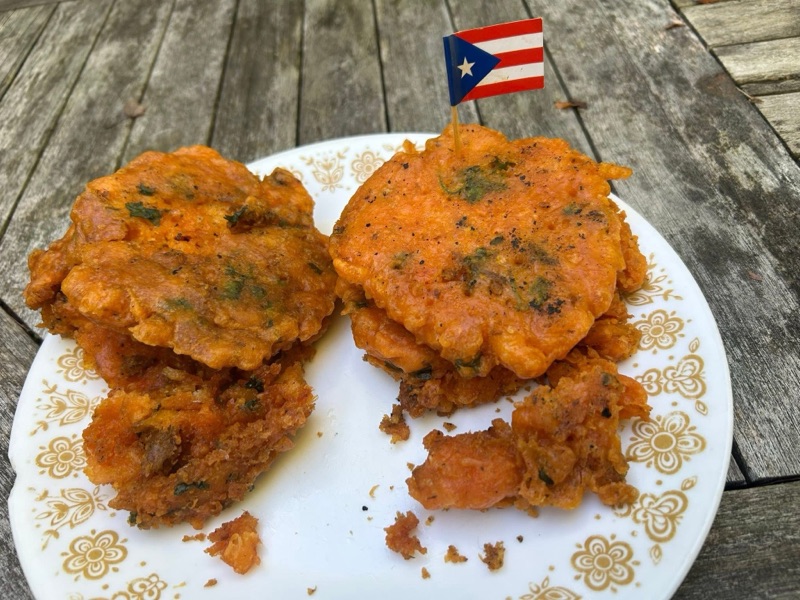
Bacalaitos, Puerto Rico’s golden, crisp-edged codfish fritters, were born in the crucible of colonial scarcity and reborn in the shadow of economic upheaval. Their origins trace back to the colonial era, when Spanish merchants brought bacalao, dried and salted cod. from the frigid North Atlantic to the tropical Caribbean. It was cheap, portable, and virtually indestructible, the perfect provision for ships and plantations. The enslaved and the poor, denied access to fresh meat or fish, learned to make miracles from its salt-cured flesh. They pounded it, soaked it, and folded it into flour and herbs, using Taíno and African frying techniques to create something both nourishing and defiant. Over time, this blend of necessity and creativity gave birth to bacalaitos, a fritter that crackled like fire in a pan, its aroma carrying through sugarcane fields and coastal shanties alike.
By the late 19th century, bacalaitos had moved from plantation kitchens to the bustling kioscos of coastal towns, Luquillo, Piñones, Loíza, where vendors fried them on makeshift stoves for dockworkers and fishermen. They were food for laborers, for migrants, for those who had little but made it stretch. A batter of flour, water, and flaked cod became a symbol of working-class ingenuity. Garlic, culantro, or adobo might find their way into the mix, but the soul of the fritter remained the same: simplicity, resilience, and the salt of survival.
Then came the storm of modernization, Operation Bootstrap.
In 1947, under the direction of Governor Jesús T. Piñero and the leadership of Luis Muñoz Marín, Puerto Rico’s government, hand in hand with U.S. capital, launched an ambitious plan: Operación Manos a la Obra. Its mission was to drag the island from its agrarian past into an industrial future. The promise was prosperity. The reality was dislocation.
Tax breaks lured American corporations, Textron, General Electric, Pfizer, to the island. The sugarcane, coffee, and tobacco industries that had sustained rural life were dismantled almost overnight. Tractors replaced machetes; factories replaced farms. Between 1947 and 1965, nearly three-quarters of Puerto Rico’s small farms vanished. The jíbaros, rural peasants who had once worked the mountains and valleys, were driven into cities or off the island entirely. Unemployment soared. By 1960, over half a million Puerto Ricans had migrated to New York and Chicago, seeking work in garment factories and shipyards. Those who stayed crowded into the edges of San Juan, Ponce, and Mayagüez, building shacks from tin and wood, surviving on meager wages and unkept promises.
And yet, amid this upheaval, the scent of frying bacalaitos never vanished.
In the cramped kitchens of urban slums, women stood over bubbling pans, stretching meager portions of imported cod into enough to feed entire families. The act itself was resistance: frying fish meant survival, survival meant defiance. These fritters became food for the displaced, for the factory worker between shifts, for the striker on a picket line. Their oil shimmered beside the fires of discontent that burned across the island.
By the late 1940s, labor unrest was rising like the tide. When sugar workers struck in Arecibo in 1949, protesting wage cuts and mechanization, bacalaitos were sold near the picket lines, cheap, portable, sustaining. In 1950, during the Nationalist uprisings that culminated in the Grito de Jayuya, the smell of cod fritters mingled with tear gas and smoke. Women fried them in hidden kitchens, feeding rebels and families alike as planes bombed their towns. As the 1950s wore on, Puerto Rico’s industrial miracle revealed its cracks. Factory wages lagged far behind the cost of living. The Ley de la Mordaza, the 1948 Gag Law, criminalized independence activism, jailing thousands under suspicion alone.
The United States called it progress. Puerto Ricans called it survival.
By 1964, dockworkers in San Juan launched strikes against automation that threatened their livelihoods. Students and workers joined, demanding dignity over dependency. Police repression was swift and brutal, tear gas, arrests, blacklists. Yet, through it all, the bacalaito persisted, passed from hand to hand, from kitchen to protest line. It was fried hope, wrapped in newspaper, sustaining those who refused to bow to austerity. Its golden crust mirrored the island’s contradictions: beautiful, fragile, forged in heat.
Writers and activists like Juan Antonio Corretjer and Pedro Albizu Campos saw in the jíbaro’s endurance a mirror of national identity. The bacalaito, born of imported fish and local labor, symbolized that same paradox, a colonial ingredient transformed into something uniquely Puerto Rican. What was once imposed from abroad became reimagined as a food of the people. The colonized took the colonizer’s cod and made it their own.
By the late 1960s, the fires of organized resistance had dimmed, but they had changed Puerto Rico forever. Commonwealth status was cemented, the Popular Democratic Party held power, and industrialization had reshaped the island’s economy, but the inequalities remained. Albizu died in 1965, broken by prison and neglect, yet his ideals survived in the workers who kept organizing, in the students who kept marching, and in the cooks who kept frying.
Today, in the plazas of San Juan and the beaches of Luquillo, bacalaitos still crackle in oil, served beside cold beers and laughter. But they also appear at rallies and protests—against austerity, against privatization, against the colonial yoke that never truly lifted. After Hurricane María, when electricity vanished and supermarkets went dark, Puerto Ricans returned to gas stoves and outdoor fires, frying bacalaitos once more. History, it seems, always circles back to the pan.
I found them to be very similar to the Jamaican stamp-and-go fritters I made a few months ago. However, the spice profile elevates this in my opinion.
Bacalaitos (Salt Cod Fritters)
Ingredients:
- ½ lb salted codfish, soaked overnight & flaked
- 1 cup all-purpose flour
- 1 tsp baking powder
- 1 packet sazón with achiote
- 1 clove garlic, minced
- 1 tbsp cilantro, chopped
- ½ tsp oregano
- ¾ cup water (adjust for batter consistency)
- Oil for frying
Instructions:
- Mix flour, baking powder, sazón, garlic, cilantro, and oregano.
- Stir in water to make a loose batter. Fold in codfish.
- Heat oil. Drop spoonfuls of batter into hot oil, flattening slightly.
- Fry until crisp & golden.
Jibarito: The Defiant Sandwich of the Young Lords
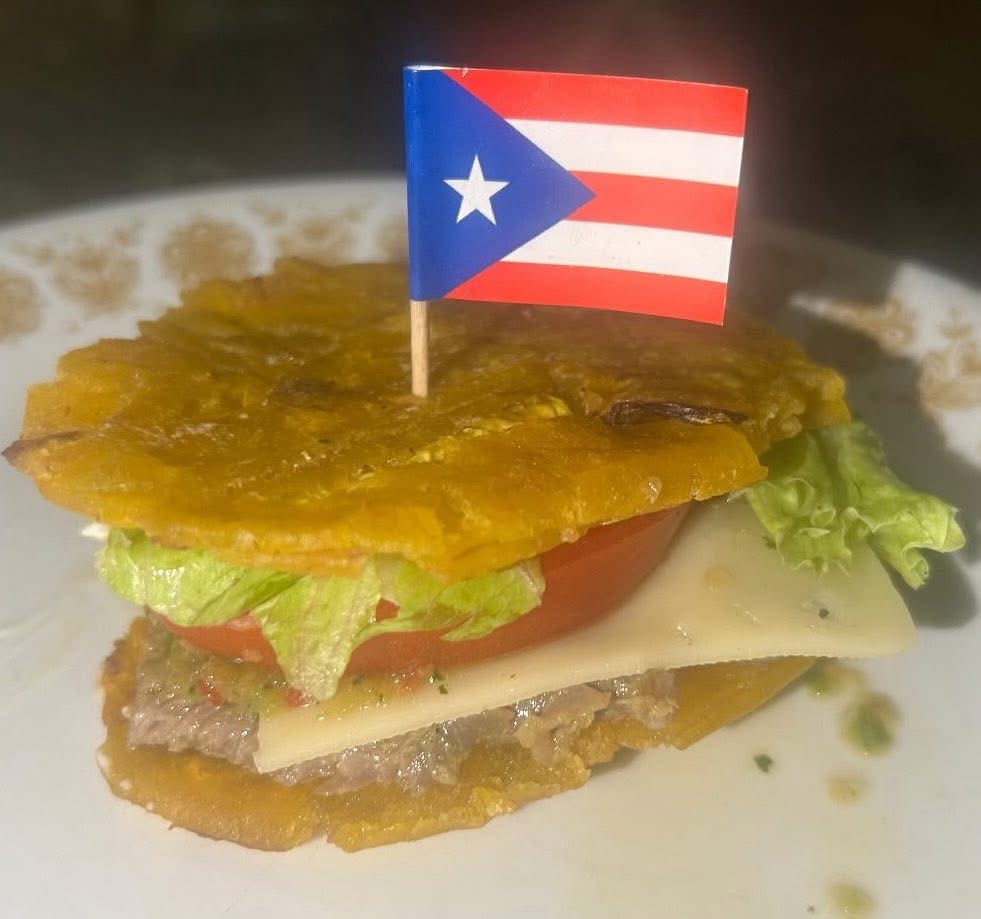
The Jibarito, Puerto Rico’s most rebellious sandwich, was not born under palm trees but under the steel shadows of Chicago’s West Side. It defied expectations from the start, replacing the soft, white bread of the American lunch counter with flattened, fried green plantains: tostones, crisp and golden, holding together steak, lettuce, tomato, garlic mayo, and sometimes cheese. It looked like no other sandwich in the city, and that was the point. It was Puerto Rican, through and through, a dish that stood its ground in a world trying to erase it.
The Jibarito was created in the 1990s by chef Juan Figueroa at Borinquen Restaurant in Chicago’s Humboldt Park, a neighborhood that had long been the beating heart of the Puerto Rican diaspora. The name itself, “Jibarito,” or “little jíbaro”, paid homage to the jíbaro, the independent mountain farmer of Puerto Rico, celebrated as the soul of the island’s working-class spirit. To call something jíbaro was to call it humble but proud, rural but wise, poor but dignified. It was the jíbaro who fed the nation through sweat and soil, who carried the island’s identity long before tourism or modernity. And it was that spirit that Figueroa fried into every slice of plantain, transforming a root once seen as peasant food into a symbol of pride on a plate.
But to understand why the Jibarito struck such a chord, you have to understand the world it was born into, the Puerto Rican diaspora of the 20th century, and the radical youth who fought to preserve its dignity: the Young Lords.
In the 1950s, Operation Bootstrap promised to modernize Puerto Rico. Factories replaced farms. Crops were uprooted for concrete. Thousands were displaced. The U.S. government and local elites framed it as progress, industrialization that would bring prosperity, but for many, it brought only unemployment and exile. By the 1960s, tens of thousands of Puerto Ricans had migrated to cities like New York and Chicago, looking for work in factories and slaughterhouses. What they found instead were slums, discrimination, and neglect.
Chicago’s Lincoln Park, once a hub of Puerto Rican life, became a target for “urban renewal”, a euphemism for eviction. Bulldozers tore through entire blocks, displacing thousands of families who were labeled “blight.” By 1968, Lincoln Park’s Puerto Rican youth were angry, disillusioned, and determined to fight back.
Out of that anger came the Young Lords, led by José “Cha Cha” Jiménez, a former gang member turned community organizer. Influenced by the Black Panther Party, they transformed their street gang into a political movement, a movement that would become one of the most powerful expressions of Puerto Rican identity on the mainland.
The Young Lords Movement, founded in Chicago and spreading to New York’s El Barrio, fused nationalism, socialism, and anti-colonialism into a single cry for liberation. Their 1969 13-Point Program demanded community control, housing, education, and independence for Puerto Rico. They called for “Power to the People,” not as a slogan but as a promise.
Their activism was bold and theatrical. In Chicago, they occupied McCormick Theological Seminary, demanding it provide affordable housing for displaced Puerto Rican families. In New York, they launched the “Garbage Offensive,” blocking traffic with piles of uncollected trash to protest sanitation neglect in East Harlem. They took over Lincoln Hospital, calling attention to its inhumane conditions, and turned churches into “People’s Churches,” offering free breakfast programs and health clinics for the poor.
The Lords didn’t just protest, they built. They fed children, tested for lead poisoning, taught Puerto Rican history, and published their own bilingual newspaper, Palante, whose very name, “Forward”, echoed their unstoppable drive. They were surveilled, infiltrated, and arrested by the FBI’s COINTELPRO, but they refused to disappear. Their mission was never just about politics, it was about identity. About refusing to become invisible in a country that treated them as if they already were.
It’s no coincidence that the Jibarito was born just blocks away from where the Young Lords once marched. By the 1990s, Humboldt Park was still struggling, poverty lingered, and gentrification loomed—but the culture endured. When Juan Figueroa pressed those green plantains flat and used them as bread, he wasn’t just innovating. He was declaring something: We don’t need to fit your mold.
In a city of hot dogs and Italian beef, the Jibarito said: We have our own sandwich, and it tastes like home.
The substitution of bread for plantain was a small act with a big meaning, mirroring the Young Lords’ rejection of assimilation. Where others saw a fried plantain, Puerto Ricans saw themselves: tough, golden, and unyielding after centuries of pressure. The garlic mayo, rich and fragrant, tied it to the island’s sofrito tradition, linking Chicago kitchens back to Caribbean shores.
At festivals and protests alike, Jibaritos became fuel for the body and sou, a portable flag of Boricua pride. Street vendors sold them near Humboldt Park’s Puerto Rican flags, their smell mingling with the chants of “¡Pa’lante, siempre pa’lante!” ("Forward, always forward!"). Like the Lords’ community kitchens, they fed the people not just with food but with affirmation: You belong here.
By 1973, after years of infiltration, arrests, and internal division, the Young Lords were dismantled. Leaders were imprisoned or forced into exile. Yet, their legacy endured. They inspired Puerto Rican studies programs at universities like CUNY, bilingual education reforms, and a generation of activists who refused to be silent.
Meanwhile, the Jibarito spread beyond Humboldt Park, appearing on menus from New York to Orlando, each version a little different, but all carrying the same message. It was a sandwich born of exile but steeped in resistance.
In the 21st century, as Humboldt Park faces new waves of displacement, the Jibarito remains a quiet act of rebellion. It’s eaten in lunch counters and family kitchens, at street fairs and protests. It says what the Young Lords said decades ago: We are still here.
This easily became one of my favorite sandwiches of all time.
Jibarito (Chicago-Puerto Rican Plantain Sandwich)
Ingredients:
- 2 green plantains, peeled & cut lengthwise
- 1 lb steak (skirt or ribeye), thinly sliced
- 3 cloves garlic, minced
- 1 tbsp adobo seasoning
- 4 slices cheese (Swiss or provolone)
- 1 tomato, sliced
- 1 cup shredded lettuce
- 2 tbsp mayo (or garlic aioli)
- Oil for frying
Instructions:
- Flatten plantain halves with a plate or press. Fry until golden, drain, flatten again, then fry until crisp. These are the “bread.”
- Season steak with garlic & adobo. Sear until cooked through.
- Assemble: plantain “bread,” mayo, steak, cheese, tomato, lettuce, plantain top.
- Serve hot & crunchy.
Pollo Guisado: The Simmering Spirit of Verano Boricua
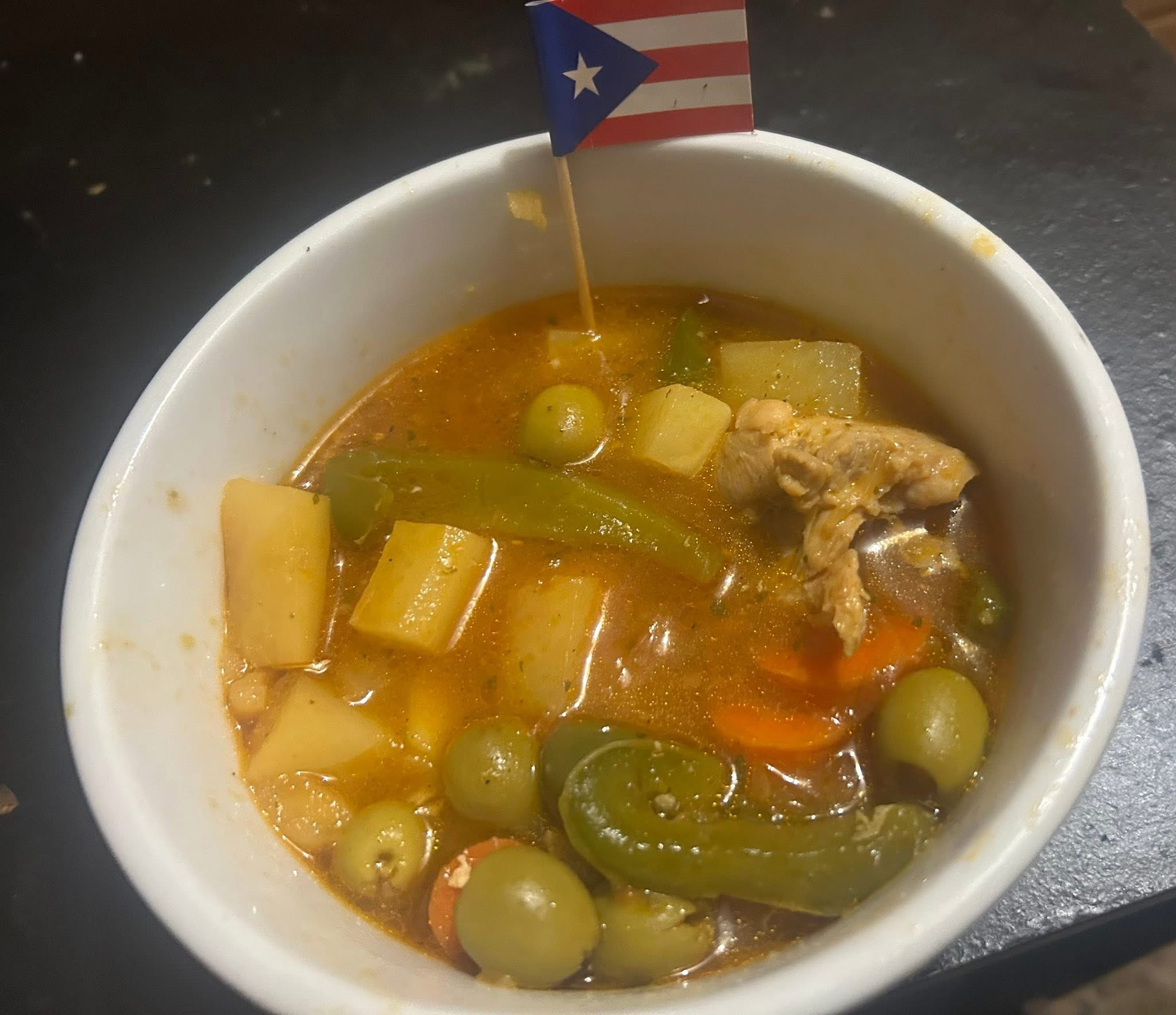
Pollo Guisado, Puerto Rico’s soul-warming stewed chicken, is the island’s version of chicken soup, a dish that gathers families and barrios around steaming pots of comfort. Its essence lies in sofrito, that fragrant blend of onions, garlic, peppers, cilantro, and culantro, which was an inheritance from the Taíno and African kitchens that survived colonial imposition. Into that aromatic base go chicken, potatoes, carrots, olives, sometimes capers, all simmered in a tomato-rich broth until tender. It’s not an expensive dish, but a resourceful one, a meal that stretches flavor as far as the pot will allow.
Its roots trace back to the colonial era, when the Spanish brought chickens to the Caribbean in the 1500s. For enslaved Africans and impoverished jíbaros in the mountains, chicken was one of the few accessible meats. Pork was prized and beef rare, but chicken, cheap, quick to raise, and endlessly adaptable, became the protein of survival. The dish’s base, sofrito, fused Taíno herbs with African spice traditions and Spanish olive oil. What emerged was not just a recipe but a metaphor: many ingredients, one flavor. By the 19th century, Pollo Guisado had become a staple of the Puerto Rican countryside. In jíbaro homes, great iron calderos simmered for hours, feeding families and neighbors alike. Every household had its twist some added sazón for color, others wine for depth but all shared the same spirit: communal, affordable, nurturing.
Over time, the dish became a ritual. Served with rice, tostones, or a ladle of broth over white grains, it symbolized home. When hurricanes knocked out power, when paychecks vanished, when families gathered for baptisms or burials, Pollo Guisado was there, a pot that could fill a dozen plates and still offer seconds. Its slow-simmered patience taught endurance; its scent, wafting through wooden houses and urban caseríos alike, became the island’s heartbeat.
That same heartbeat pounded through the streets in the summer of 2019, during El Verano Boricua, the Puerto Rican Summer. What began as a leak of 889 pages of Telegram messages soon boiled into the island’s largest social uprising. Governor Ricardo Rosselló, already presiding over a debt-ridden and hurricane-battered colony, was exposed mocking women, LGBTQ+ activists, and the very victims of Hurricane Maria. The chats confirmed what Puerto Ricans had long suspected: that corruption and contempt had become policy. But this time, they refused to swallow it.
On July 13, thousands flooded San Juan’s cobblestone streets, banging pots, cacerolazos, in rhythmic defiance. By July 22, half a million people marched in the Marcha del Pueblo, the People’s March, filling highways with flags and chants. Police fired tear gas. Protesters danced salsa in the streets. Bad Bunny and Residente performed live on protest trucks, transforming anger into art. For twelve days, the island pulsed like a single, unified drum. Feminist collectives, labor unions, and students set up aid stations and kitchens to sustain the crowds. Volunteers ladled out Pollo Guisado from industrial pots, feeding marchers who had been chanting for hours beneath the Caribbean sun. The dish became protest fuel, a literal embodiment of el pueblo feeding itself when the state would not.
In those protest camps, Pollo Guisados served as both food and metaphor. Its sofrito, a mix of disparate elements melding into harmony, reflected the coalition that had formed: urban youth, rural jíbaros, diaspora returnees, feminists, artists, and elders. Like the stew, the movement built flavor through patience. Each ingredient, each group, contributed its own note, until the whole became impossible to ignore.
The government’s indifference had been decades in the making. The 2016 PROMESA Act, imposed by the U.S. Congress, had placed Puerto Rico under the control of an unelected fiscal board, slashing pensions, closing schools, and deepening poverty to repay Wall Street creditors. Unemployment soared to 14%. Then came 2017’s Hurricane Maria, a catastrophe that revealed the island’s colonial fragility. Nearly 3,000 died, many from neglect and delay, their deaths minimized by Rosselló’s administration. When the RickyLeaks surfaced, the island’s rage had already been simmering for years. Verano Boricua was the boil-over.
For twelve days, the people took back their streets and kitchens alike. Families who had once gathered around pots of Pollo Guisado now gathered around barricades, sharing food from Tupperware as police sirens wailed. Feminist groups led community kitchens that fed protesters for free, often cooking the same dishes they had grown up with in their mothers’ calderos.
Rosselló tried to wait them out. He flew back from Europe, fortified La Fortaleza, and offered half-apologies. But the pot had boiled over. The general strike of July 21 brought the island to a standstill. The next day, 500,000 people flooded Old San Juan. It was no longer a protest, it was a carnival of reclamation. They danced perreo combativo, protest twerking, in front of riot shields. They sang, cooked, banged pots, and refused to disperse. On July 24, cornered by his own legislature and the people he’d mocked, Rosselló resigned, the first Puerto Rican governor ever to be toppled by protest.
Yet, as with any stew, the story didn’t end when the heat was turned off. The aftermath revealed deeper hunger. His successor, Wanda Vázquez, faced new demonstrations. The PROMESA board still ruled. Austerity persisted. And yet, something irreversible had changed: Puerto Ricans had learned the power of collective simmering. Community kitchens blossomed across the island, from earthquake relief efforts in 2020 to pandemic food programs in 2021. The same hands that once stirred Pollo Guisado for family now stirred for strangers, for neighbors, for the cause of dignity itself.
In the wake of Verano Boricua, as Puerto Rico continues to wrestle with its colonial status and economic wounds, Pollo Guisado still simmers on countless stoves. Each pot, bubbling with sofrito and solidarity, is the simmering spirit of Verano Boricua.
Pollo Guisado quickly became one of my favorite soups ever. Flavorful and easy to make, I highly suggest you try it.
Pollo Guisado (Puerto Rican Stewed Chicken)
Ingredients:
- 2 lbs chicken thighs/drumsticks
- 3 tbsp sofrito
- 1 packet sazón with achiote
- 2 tbsp adobo seasoning
- 1 bell pepper, sliced
- ½ onion, sliced
- 2 tbsp tomato paste
- 2 potatoes, cubed
- 1 carrot, sliced
- 2 cups chicken broth
- 2 tbsp olive oil
- Salt & pepper
Instructions:
- Season chicken with adobo & sazón. Brown in oil.
- Add sofrito, peppers, onion, tomato paste. Cook until fragrant.
- Stir in potatoes, carrots, and broth.
- Simmer covered 35–45 min until chicken is tender & sauce thickens.


Comments
Post a Comment